


Mail Blaze | List Health | 3 min read
Mail Blaze | List Health | 3 min read
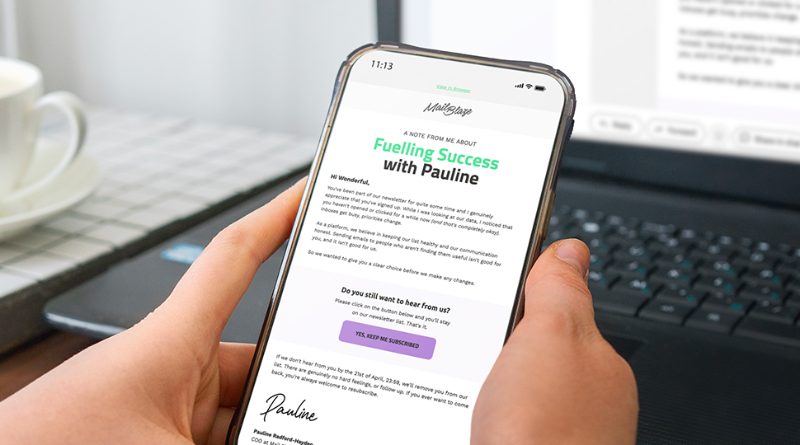
A reconfirmation campaign, sometimes called a re-permission campaign, is the process of asking existing subscribers to actively confirm that they still want to receive your emails.
Done well, it is one of the most valuable things you can do for a list that has developed a consent or engagement problem. Done badly, it is an exercise in anxiety about subscriber numbers that ends with nothing actually fixed. H ere is how to do it properly.
When a reconfirmation campaign is the right move
A reconfirmation campaign makes sense when:
- You have a significant segment of subscribers who have not engaged in six months or more
- Your list includes contacts imported in bulk whose original consent record is unclear
- You are changing your email programme significantly, moving to a new platform, changing your send frequency, or shifting your content focus
- Your deliverability metrics have declined and you need to rebuild sending reputation from a cleaner base
- You are entering a regulated market or expanding into regions with stricter consent requirements
It is not a solution to every problem. If your list has always been built on clean consent and your engagement is healthy, a reconfirmation campaign is unnecessary and will cost you subscribers you do not need to lose. Use it when you have a real permission gap to close.
Step 1: Identify the segment
Do not send a reconfirmation campaign to your entire list. Send it to the subscribers who need it.
The most common targets are: subscribers who have not opened or clicked in the past six to twelve months; contacts added through bulk imports with no individual consent record; and any segment where the original sign-up source is unclear or known to be low quality.
Keep your active, engaged subscribers out of this process entirely. They have already confirmed their interest through their behaviour. Asking them to reconfirm is unnecessary friction.
Step 2: Write the email
A reconfirmation email has one job: make it completely clear what you are asking and make it easy to say yes.
The structure that works:
- A direct, honest subject line. Something like "Do you still want to hear from us?" works better than anything clever. This is not the moment for curiosity gaps.
- A brief, honest explanation. You are checking in because you want to make sure your emails are still relevant and wanted. No guilt, no pressure.
- One clear call to action. A single button: "Yes, keep me subscribed" or "Stay on the list." Not two buttons, not a link buried in the copy.
- A clear statement of what happens if they do not click. Something like: "If we do not hear from you by [date], we will remove you from our list. No hard feelings." Be specific about the date.
- An easy unsubscribe option. If they want to leave, let them. The goal is consent, not retention at any cost.
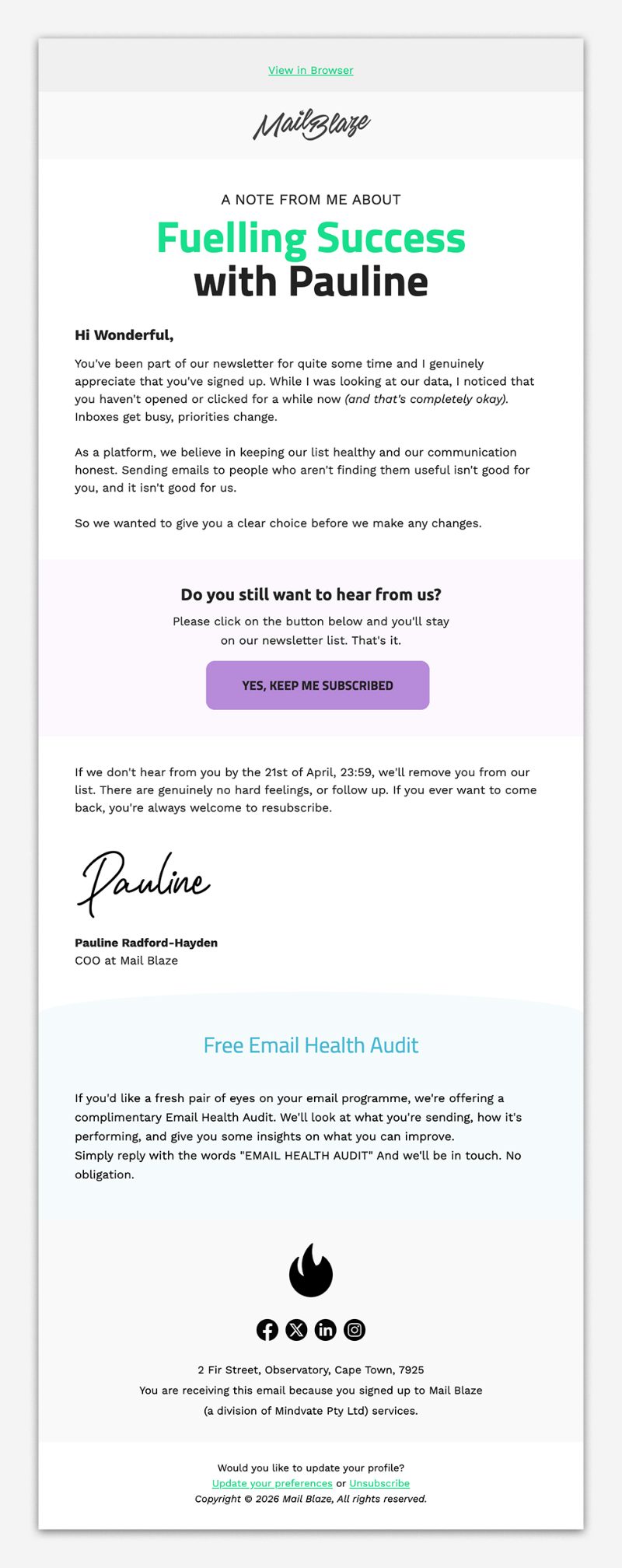
What to avoid: emotional pressure, lengthy explanations about why their subscription matters, multiple CTAs that create confusion, and vague language about what "staying subscribed" means.
Step 3: Handle the non-responders
This is the step most marketers hesitate on. When the deadline passes and a subscriber has not clicked, remove them.
Not archive them. Not put them in a suppression list and revisit later. Remove them from your active sending list.
This feels counterintuitive when you are looking at the numbers. But a subscriber who did not respond to a direct, clear request to confirm their interest is not an engaged subscriber. They are a liability: contributing to the inactive proportion of your list that is dragging down your metrics and your deliverability.
The list you have after a reconfirmation campaign is smaller. It is also better in every way that actually matters.

What comes after
Once the reconfirmation campaign is complete, the work is to not recreate the same problem. That means building consent properly from every new sign-up point, auditing your list periodically rather than waiting for a crisis, and treating engagement data as an ongoing signal rather than something you check once a quarter. Make it part of a greater data hygiene campaign and a last step before you “sunset subscribers.”
After all, a reconfirmation campaign is a reset. What you do after determines whether it was worth it.
Explore further about Content Marketing article here.

Maximising email engagement: Strategies and tactics
Every marketer knows that sending emails is still a great way to reach people. But without the right tricks under your belt, it can be more difficult to engage your subscribers than it needs to be....

Best Email Marketing Platforms in South Africa 2026
Compare the top email marketing platforms in South Africa, local versus international. Mail Blaze, Touchbase pro Mailchimp and more compared
Fuelling Success with Springnest
We chat to Springnest, an online platform helping tourism and hospitality properties build and maintain their websites. Springnest clients can now enjoy the ease of the latest Mail Blaze integratio...
Explore further about Content Marketing article here.
Maximising email engagement: Strategies and tactics
Every marketer knows that sending emails is still a great way to reach people. But without the right tricks under your belt, it can be more difficult to engage your subscribers than it needs to be....
Best Email Marketing Platforms in South Africa 2026
Compare the top email marketing platforms in South Africa, local versus international. Mail Blaze, Touchbase pro Mailchimp and more compared
Fuelling Success with Springnest
We chat to Springnest, an online platform helping tourism and hospitality properties build and maintain their websites. Springnest clients can now enjoy the ease of the latest Mail Blaze integratio...
Maximising email engagement: Strategies and tactics
Every marketer knows that sending emails is still a great way to reach people. But without the right tricks under your belt, it can be more difficult to engage your subscribers than it needs to be....
Maximising email engagement: Strategies and tactics
Every marketer knows that sending emails is still a great way to reach people. But without the right tricks under your belt, it can be more difficult to engage your subscribers than it needs to be....
Best Email Marketing Platforms in South Africa 2026
Compare the top email marketing platforms in South Africa, local versus international. Mail Blaze, Touchbase pro Mailchimp and more compared
Fuelling Success with Springnest
We chat to Springnest, an online platform helping tourism and hospitality properties build and maintain their websites. Springnest clients can now enjoy the ease of the latest Mail Blaze integratio...
Still haven't found what you are looking for?
Book a demo with us and see Mail Blaze in action, or reach out to our support team for expert assistance. We're here to help you every step of the way!
Still haven't found what you are looking for?
Still haven't found what you are looking for?
Book a demo with us and see Mail Blaze in action, or reach out to our support team for expert assistance. We're here to help you every step of the way!
Book a demo with us and see Mail Blaze in action, or reach out to our support team for expert assistance. We're here to help you every step of the way!
2026 © Mail Blaze. All rights reserved.