


Mail Blaze | 10 min read
Mail Blaze | 10 min read

Partnerships are about more than integrations - they’re about shared values, shared goals, and creating something better together. Following our recent collaboration with Springnest, Pauline, Mail Blaze COO, spoke with Lilian Padiachy, their Customer Experience Specialist, to learn more about their platform, how email marketing and website building connect and learn a whole bunch of tips and tricks that help property owners work on their online presence. We also hear from Co-founder, Peter Fabricus, why a partnership between Springnest and Mail Blaze made sense, as well as what Springnest’s design philosophy is.
Pauline: Can you give us a brief overview of Springnest and what you do for property owners?
Lilian: Sure! Springnest helps tourism and hospitality properties build, market, and maintain professional websites that drive more direct bookings. We're a fully remote team and we've built our own proprietary content management system (CMS) specifically for the tourism industry. Unlike platforms like WordPress or Squarespace, our product is designed specifically around the needs of tourism brands: to convert website visitors into direct bookings.
With Springnest, property owners get a hassle-free way to build a website tailored to their brand. We empower our clients to market and maintain their website on an ongoing basis with expert support and guidance. We primarily serve hotels, safari lodges, guest houses, unique stays, and activity providers, and work with customers across the globe (recently Belgium, Botswana, Tanzania, Mauritius, and Fiji!)
Pauline: That’s so exciting! You serve a diverse audience with similar needs. How do you see email marketing and building your website working together for property owners?
Lilian: Your website and email marketing serve different roles, but they work best together. Your website should be intentional and equipped with the essentials. For small property owners, every page needs to work hard. A newsletter signup on your website or an opt-in when someone completes a contact form or booking opens the door to ongoing communication. Once you have that data, you can send targeted messages based on what you know about subscribers and past guests.
A new subscriber who hasn't booked yet? Educate them about your location, share trending activities, then offer a direct booking discount.
Past guests? Keep them in the loop with seasonal offers, local events, and reminders of what made them love your property.
Your website is one way someone becomes a guest. Email marketing is how they become your guest.
Pauline: That’s a great way to look at it, almost like your website invites the visitor to become part of your audience. What’s the most common challenge you see property owners facing when it comes to their online presence?
Lilian: Peter and I work at different touchpoints of the customer journey, so we see these challenges from complementary angles.
From my side, a common challenge is that properties often under-explain why they’re worth booking direct. Many properties know they offer something special, but struggle to articulate it clearly online, especially when competing against look-alike listings on online travel agencies (OTAs).
Peter's noticed similar patterns and added a few more, like the battle for driving more direct bookings through their own websites, as opposed to OTAs and booking platforms that charge high commissions.
Finding the time to juggle online marketing and reservations, everything from taking bookings, updating website content, posting on socials, sending emails, adapting to AI, and the day-to-day running of their businesses. The pace of change. Like other sectors, the tourism and hospitality space is constantly being disrupted by technology and innovation. Properties find it challenging to keep up. Part of what we do at Springnest is solving this by offering proactive innovation.
Pauline: I can imagine in that space there’s already so much going on. At what stage of their business do property owners typically come to you?
Lilian: We work with property owners at every stage. If I had to sum it up I’d say:
- first-time guesthouse owners who need to establish credibility online and compete with other brands.
- properties undergoing ownership transitions that need to rebrand quickly without losing momentum.
- Hotel or safari groups who need to manage multiple properties across a specific region and need to create consistency across multiple sites without sacrificing each property's unique identity
A pattern we see with established properties who make the switch to Springnest is that they realize their current website isn't working hard enough for them, or managing content has become too difficult. There's depth to Springnest's experience that allows us to offer professional websites fit for each stage. The biggest misconception is that once you launch a website, direct bookings will just start rolling in. Building and maintaining a website takes work, but it's so worth it!
Pauline: This is so true for every marketing channel I find, people want to skip the basics, but want the results. If a property owner does have a website but isn't getting direct bookings, what are the top 3 things they should check or fix?
- Are you incentivising website visitors to book directly? Offer something on your website that visitors can't get anywhere else, a 10-15% discount, free late checkout during low season, or restaurant vouchers. Then build the offer into your booking platform so it's seamless.
- Are you using email to stay top-of-mind with past and potential guests? Use data from bookings to create targeted lists. Birthday emails with discount codes. Activity-focused campaigns about whale watching season or game drive updates. Give people reasons to come back.
- Is your website making it easy for visitors to say yes? A well-informed guest is more likely to make a booking decision. Use images and text together to tell the full story. Structure content so that it’s easily skimmable, use clear headings, intentional FAQ pages, and use high-resolution photos on your website. Focus on closing information gaps with your website.
Pauline: How important is it for property owners to own their own website vs. relying solely on OTAs (Online Travel Agencies) and booking platforms?
Lilian: When guests book through OTAs, that platform owns the relationship and data. With your own website and booking platform, you gather email addresses, preferences, and booking patterns. This lets you build a guest database for remarketing, personalisation, and repeat bookings.
OTA commissions scale with your bookings. The more you earn, the more you pay. A website subscription is a fixed cost that becomes more valuable the more direct bookings you drive. While OTAs are useful for visibility, your website is the asset you own and the foundation for sustainable direct bookings.
Pauline: That’s so true, you’re getting bookings and exposure at a fee, but also “sacrificing” the ownership of that data. I think that’s where email can be beneficial. What role do you think email marketing can play in driving traffic to a property website?
Lilian: Your website tells the full story of the guest experience and houses location-specific content. Email marketing drives the right people back to that content at the right time. Since you own guest data, you can segment your audience and send messages that feel personal, not generic.
Here are 3 ways they work together:
- A blog post about local niche activity (popular restaurants, wine routes, weather patterns for activities, etc.): Email it to a targeted list with a call-to-action to book.
- New or upgraded facilities: Inform your subscribers about renovations, new amenities, or enhanced spaces, educating them on what's changed and inviting them to experience it for themselves.
- Reward guests for sharing their feedback: Let guests know you acted on their suggestions and how it led to real improvements at your property, then reward them with a discount code for their next stay.
Your website creates content worth sharing. Email gets it in front of the right guests at the right moment, creating a cycle where both channels amplify each other.
Pauline: Complete this sentence: "Property owners should stop worrying about and start focusing on ."
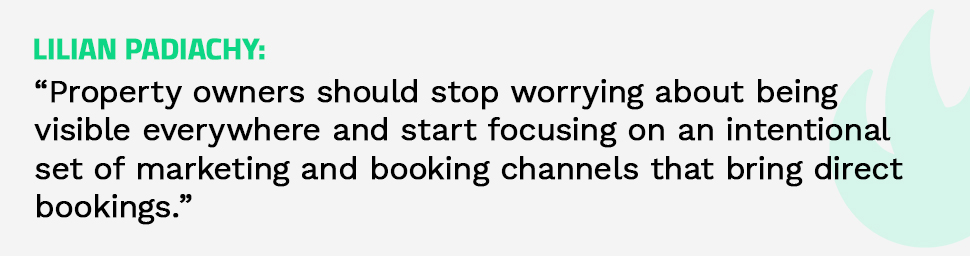
Lilian: Property owners should stop worrying about being visible everywhere and start focusing on an intentional set of marketing and booking channels that bring direct bookings.
Pauline: What's one feature of Springnest that property owners don't know about but should be using?
Lilian: Ah, I’d actually say there are two underrated Springnest features:
- Instagram Widget: It's a simple way to add visual appeal to your website. We display your Instagram grid in a horizontal format at the bottom of each page. The dual benefit: drive awareness to your Instagram and add another layer of visual storytelling across your entire site
- An exit intent Popup: With Springnest, you can enable a single Popup on your website, built for a specific purpose. I think exit intent Popups aren't widely used, but can become a useful driver for direct bookings. Give website visitors a reason to stay for a few more minutes by linking to a special offer.
Pauline: I’ve done some web builds in my life and it’s not always something for the faint hearted. For someone who's never built a website before, what does the process actually look like? How long does it take to get up and running?
Lilian: The process typically takes 20 days, depending on how quickly we receive content and feedback. The best part is that you don't need technical knowledge.
When building a website with Springnest the process looks like this:
- Content Gathering: We collect everything needed to tell your property's story: images, copy, brand details.
- Design & Build: Our team builds your website, turning your content into a clear story that matches your property's experience.
- Review and Refine: We pride ourselves on an asynchronous review process we’ve developed, which removes the exhausting feedback meetings and design by committee often found in traditional web design projects. We share an on-demand video walkthrough of the draft for the customer to watch at their own pace or circulate for comment, and based on the feedback, apply a round of changes.
- Launch Concierge: We handle securing your domain and launching the site. You get access to manage your site on an ongoing basis.
Pauline: That sounds super seamless. As we’re talking about design, I wanted to share Springnest’s design philosophy. It’s one of the things Peter and I feel strongly about, how design can be such a blocker for moving forward in your digital journey.
Peter: Yes, it really is! We built Springnest because we felt that the traditional web design model is simply not viable for properties. Brands obsess over wanting their websites to be “unique”, and feel a sense of ownership when they spend a large chunk of their marketing budget and time on launching a new site. In reality, the factors that drive direct bookings and revenue are simple: reliable, fast, mobile-first design, seamless integration with the other tools in their tech stack, and the flexibility to manage their own content with ease.
Our first love was website design, and that won’t change. We’re passionate about delivering beautiful websites that compete with world-class standards, but we’re also ruthless about bells and whistles that won’t affect our customers’ bottom line.
Pauline: Yes, I think this is why we felt synergy when initially discussing a potential partnership, but I’ll let you share your thoughts. What made you decide to partner with Mail Blaze? What synergies did you see between our platforms?
Peter: Many of the email marketing platforms we recommended to Springnest customers in the past have evolved into “all-in-one” marketing automation products. While those platforms have their purpose, they tend to be complex and technical for smaller businesses. We were drawn to the fact that Mail Blaze focussed on email, and does that really well. The product’s pricing structure and approach to customer support made it a no-brainer. Partnering with other South African software solutions doesn’t hurt either ;)
Whether you’re launching a new property website or trying to get more value from the one you already have, the takeaway is simple: your website builds trust, and your email marketing keeps the relationship going. If you’d like to see what Springnest can do for your property, you can get in touch with the team via their website.. And when you’re ready to pair it with Mail Blaze, our support article will guide you through the setup and next steps: How to Connect Springnest and Mail Blaze.
If you’re already a Springnest client, we’ve also created Springnest-specific templates based on the existing website themes available scroll down to choose one and send your next campaign with confidence.

Explore further about Content Marketing article here.

Why switch to Mail Blaze?
Mail Blaze is a marketing automation system made specifically for companies that use email to communicate with their target audiences. Find out about the value of email marketing as well as what Ma...

Fuelling Success with We Love Pets SA
We’ve been doing some great work with We Love Pets, a supplier of pet-based products that specifically focuses on the South African market and that aims to bring locally made and sourced pet prod...

It’s instant, it’s innovative, it’s Instagram: How to grow your email list with Instagram
Are you eager to unlock the secrets of leveraging Instagram to skyrocket your email list? Look no further! In this electrifying article, we reveal 6 mind-blowing strategies that will have your emai...
Explore further about Content Marketing article here.
Why switch to Mail Blaze?
Mail Blaze is a marketing automation system made specifically for companies that use email to communicate with their target audiences. Find out about the value of email marketing as well as what Ma...
Fuelling Success with We Love Pets SA
We’ve been doing some great work with We Love Pets, a supplier of pet-based products that specifically focuses on the South African market and that aims to bring locally made and sourced pet prod...
It’s instant, it’s innovative, it’s Instagram: How to grow your email list with Instagram
Are you eager to unlock the secrets of leveraging Instagram to skyrocket your email list? Look no further! In this electrifying article, we reveal 6 mind-blowing strategies that will have your emai...
Why switch to Mail Blaze?
Mail Blaze is a marketing automation system made specifically for companies that use email to communicate with their target audiences. Find out about the value of email marketing as well as what Ma...
Why switch to Mail Blaze?
Mail Blaze is a marketing automation system made specifically for companies that use email to communicate with their target audiences. Find out about the value of email marketing as well as what Ma...
Fuelling Success with We Love Pets SA
We’ve been doing some great work with We Love Pets, a supplier of pet-based products that specifically focuses on the South African market and that aims to bring locally made and sourced pet prod...
It’s instant, it’s innovative, it’s Instagram: How to grow your email list with Instagram
Are you eager to unlock the secrets of leveraging Instagram to skyrocket your email list? Look no further! In this electrifying article, we reveal 6 mind-blowing strategies that will have your emai...
Still haven't found what you are looking for?
Book a demo with us and see Mail Blaze in action, or reach out to our support team for expert assistance. We're here to help you every step of the way!
Still haven't found what you are looking for?
Still haven't found what you are looking for?
Book a demo with us and see Mail Blaze in action, or reach out to our support team for expert assistance. We're here to help you every step of the way!
Book a demo with us and see Mail Blaze in action, or reach out to our support team for expert assistance. We're here to help you every step of the way!
2026 © Mail Blaze. All rights reserved.